Past Rick Steves
Telephone-based map apps have taken much of the pain out of finding our fashion on road trips. But what most when nosotros're overseas, where a phone connection might not be all that cheap, or fast? No road trip is without its wrong turns — but deciding on the best map apps, whether to use a GPS device, and arming yourself with some key tips for navigating in Europe can go a long way toward saving fourth dimension and frustration.
My best tip for navigating unfamiliar terrain: Don't rely blindly on your phone'south mapping app or a GPS device for directions. E'er have at least a vague sense of your route, go on a newspaper map handy, and pay attending to road signs so yous can consider alternatives if you feel the GPS route is Getting Pretty Screwy.
Maps and Apps
Whether it's a map app on your phone or an old-school driver's atlas, a well-designed map of any kind is a must-have on whatsoever European road trip.
Mobile Mapping Apps
The mapping app on your phone works fine for navigating Europe'due south roads. The downside is that to get existent-time plow-by-turn directions and traffic updates, you lot'll need Internet access (a business abroad, where you are likely paying more for data).
For well-nigh travelers concerned about data roaming, the best option is an app that works offline: Google Maps, Here WeGo, and Navmii will give you turn-by-turn vocalism directions without a data connection — and if you brand a wrong plow, will recalibrate and send yous on the correct mode. They substantially offer nearly all the advantages of a dedicated GPS system, only on your smartphone — for free.
Download your map earlier you head out (information technology'southward smart to select a big region). Then plough off your cellular connection and so you're not charged for information roaming. Recall the map, enter your destination, and you're on your manner. For the best performance in Google Maps, use standard view (not satellite view) to limit information demands.
Be aware that Google Maps' traffic setting does not piece of work offline, then check for slowdowns and detours before you striking the road or utilise data roaming for a brief catamenia to become current weather condition. And bring a car charger for your device, since mapping apps, even offline, gobble upwards bombardment life. It's likewise smart to bring a motorcar mount for your telephone that works for lots of vehicles.
Equally of the last update to this article, other navigation apps — such as Apple Maps and Waze — practice not offer turn-by-turn directions offline. GPS apps from TomTom, Garmin, CoPilot, and others do work offline but tend to exist very expensive.
GPS Devices
If yous'll be traveling without a smartphone, or desire the convenience of a dedicated GPS, consider renting a GPS device with your car ($x–30 per day). Information technology'll requite y'all real-time turn-by-turn directions and traffic without the data limitations of a phone app. Annotation that the unit may come up loaded just with maps for its home state; if you need additional maps, ask. Likewise make certain the device is gear up to English earlier you drive off.
The other option is to bring a GPS from abode. Yous'll probable demand to buy and download European maps before your trip (check that the maps available through the manufacturer are detailed enough for the areas you lot're visiting). Remember to bring your unit's car charger and a portable machine mount.
Paper Maps and Atlases
Even when navigating primarily with a phone app or a GPS device, I always accept a newspaper map on hand. It's invaluable for getting the big picture, understanding alternate routes, and filling in when my phone runs out of juice.
The free maps you get from your car-rental company commonly don't have enough detail. Better maps and atlases are sold at European gas stations, bookshops, newsstands, and tourist shops. Michelin offers skillful individual regional maps and road atlases for each country (with good city maps and detailed indexes). Though they tin be heavy, atlases are meaty, a good value, and easier for drivers to use than big foldout maps.
Sometimes the best regional road maps are available locally. For example, if you're exploring your roots in the Norwegian fjord land, Cappelens 1:200,000 maps are detailed enough to help you detect Grandpa Ole's farm. Other quality European brands include Hallwag, Freytag & Berndt, Marco Polo, Berndtson & Berndtson, AA (Britain'southward AAA-type automobile club), Road Editions (for Greece), and Kod & Kam (for Croatia and Slovenia).
Smart Navigation
Your trip will go more smoothly if you familiarize yourself with the quirks of navigating in Europe.
Signs and Symbols
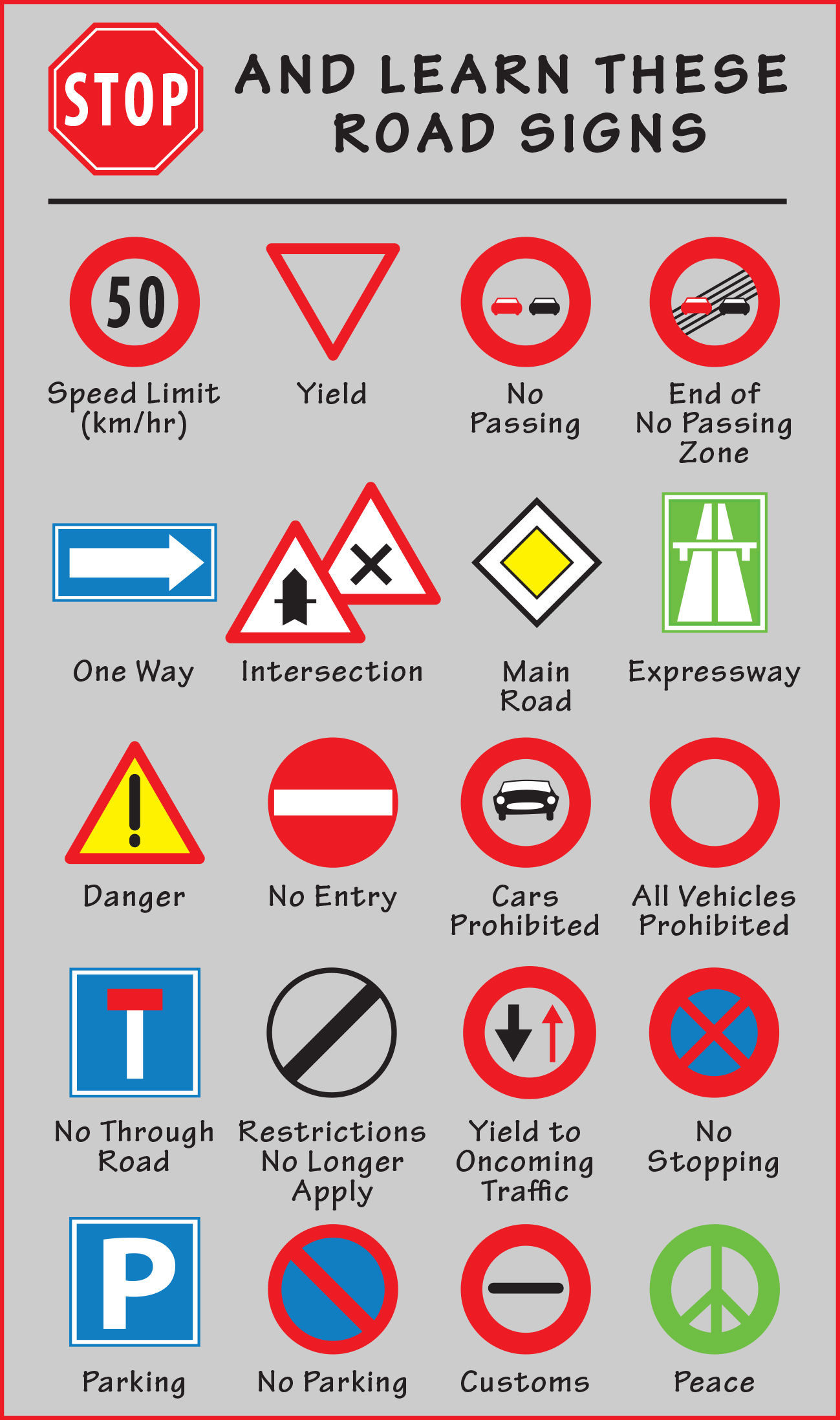
All of Europe uses the same elementary set of route symbols; information technology takes just a few minutes to acquire them (meet image). Many superhighway rest stops have local driving almanacs (or cheap maps) that explain such signs, roadside facilities, and exits.
Metric Distances
European countries (except the Uk) use kilometers instead of miles. I kilometer is six-tenths of a mile. To catechumen kilometers to miles, cut the kilometers in one-half and add together x percent of the original number (360 km = 180 + 36 = 216 miles; 90 km/hour = 45 + 9 = 54 mph — non very fast in Europe). Some people prefer to drop the concluding digit and multiply by half-dozen (if lxxx km, multiply 8 × vi = 48 miles), though this can be challenging with large numbers (340 km × 6 = ?). Choose whichever formula works for y'all.
When estimating how long a drive will take, figure you lot'll average 100 kilometers per 60 minutes on expressways (about the same as going 60 mph back home). Determining how much ground you tin cover off the freeway is a crapshoot. I apply a play a joke on an Irish bus driver taught me: Effigy a infinitesimal for every kilometer (roofing 90 km will take you about an hour and a half). Double that for boring, curvy roads, such as in Italy's Dolomites or along its Amalfi Coast.
Navigating by Road and Boondocks Names
Written report the roads and major interchanges you'll be using before you set out. If you're headed for a modest or midsize town, know which big city is nearby (and most likely to be signposted) to keep y'all headed in the right direction.
In some countries, route numbers can help you find your way: For instance, accept road A-ane to London, so B-23 to Bristol, then C-456 to Bath. Normally, the more than digits the road number has, the smaller it is; and then in United kingdom of great britain and northern ireland, M-1 is a freeway, A-34 is a major road, and B-4081 is a secondary road. In other countries, local signs ignore the route numbers (which tin change along the way), so it's necessary to navigate by town name. Signs are oftentimes color-coded: yellow for almost roads, green or bluish for expressways, and brown for sightseeing attractions.
Well-nigh international European expressways are designated with an "Due east" (similar to the "I" designation on American freeways), just they may besides exist labeled on maps and signs with their national letters (for example, the principal route between Paris and Lyon is known as both "A-half-dozen" and "E-fifteen").
City Centers
Yous can drive in and out of foreign towns fairly smoothly past following a few bones signs. Most European towns have signs directing you to the "sometime town" or the eye (such as centrum, centro, centar, heart-ville, Zentrum, Stadtmitte). Near tourist offices, usually right downtown, are clearly signposted (i, turismo, VVV, or various abbreviations that y'all'll learn in each country). The tallest spire often marks the middle of the one-time town. Park in its shadow and look for the tourist information office. When leaving a urban center, look for "all directions" signs (toutes directions, alle Richtungen, etc.) pointing you out of town.
When you reserve your hotel room, ask your hotelier — or at least check their website — for tips on avoiding annihilation potentially tricky almost reaching the hotel by car (especially if your hotel'south in a dense Onetime World maze of streets). If possible, figure out your inflow road earlier you enter the metropolis limits. While some small-scale towns helpfully mail service signs directing you to private hotels, in many cases you're on your own. If your hotel is inside a restricted driving area, ask your hotelier to annals your auto ahead of your arrival or direct you lot to legal parking.
DOWNLOAD HERE
Posted by: snowwoot1953.blogspot.com


0 Komentar
Post a Comment